Optimal taxation in a habit formation economy
by Sebastian Koehne and Moritz Kuhn
Published in Journal of Public Economics, Volume 122, February 2015
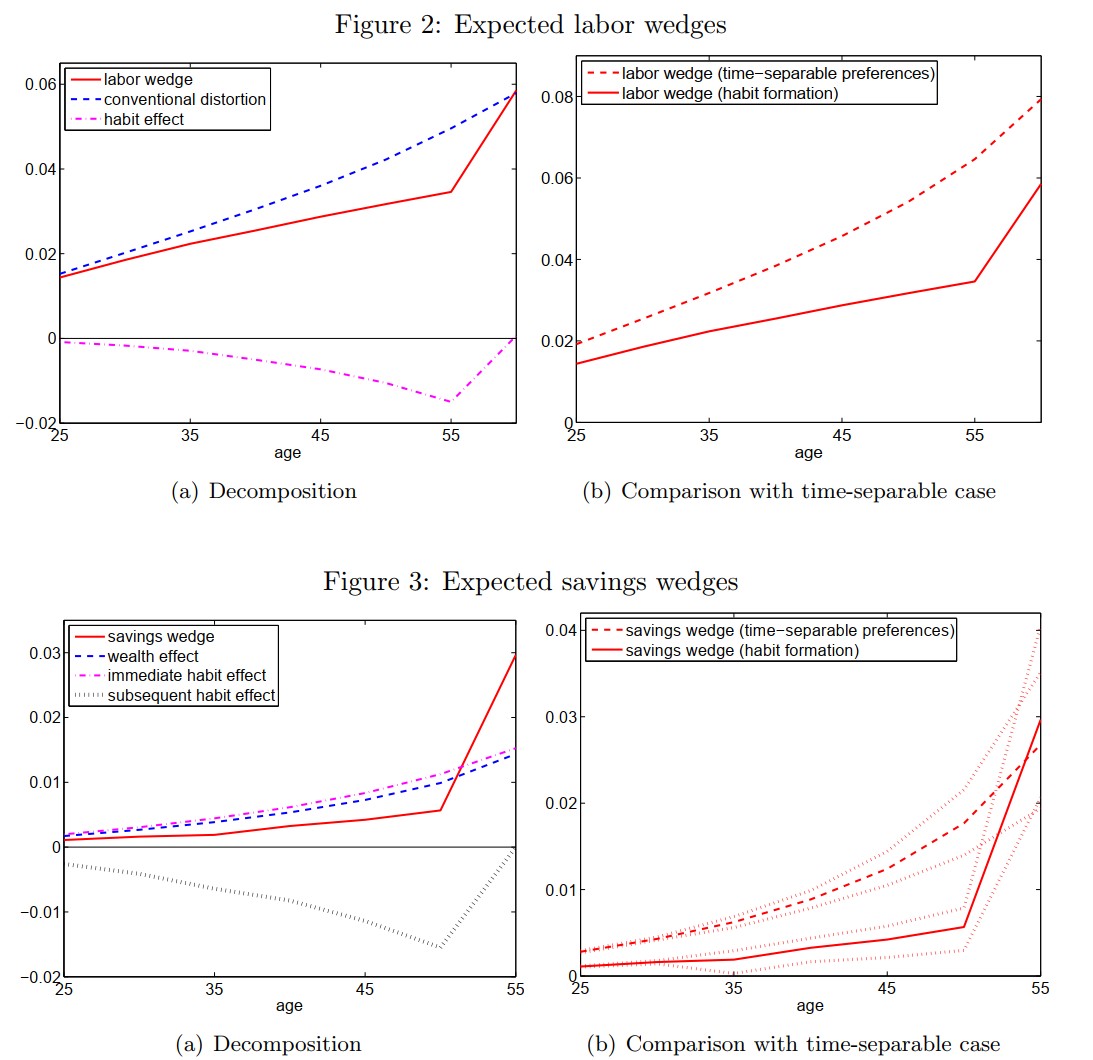
This paper studies habit formation in consumption preferences in a dynamic Mirrlees economy. We derive optimal labor and savings wedges based on a recursive approach. We show that habit formation creates a motive for subsidizing labor supply and savings. In particular, habit formation invalidates the well-known “no distortion at the top” result. We demonstrate that the theoretical findings are quantitatively important: in a parametrized life-cycle model, average labor and savings wedges fall by more than one-third compared with the case of time-separable preferences.
Paper
Most Recent Working Paper [Link]
Published Version [Link]