
Employment, Occupation, and Financial Situation
Using 2022 Survey of Consumer Finances data, this page compares household income and wealth across employment statuses. It also examines how financial resources vary across the occupations of employed households, accounting for other household characteristics.
Employment status and inequality: Income
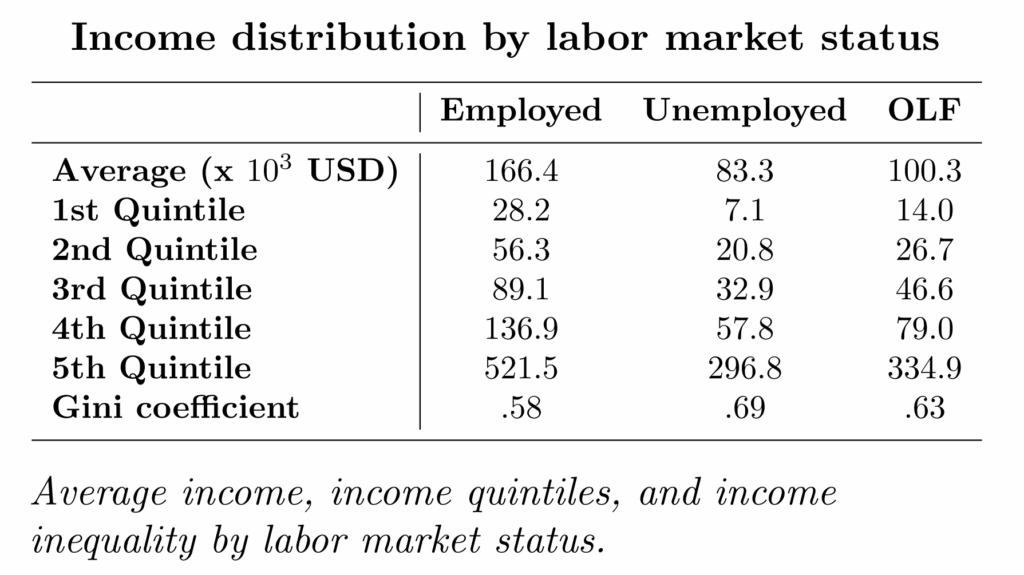
Income and wealth distributions across employment statuses exhibit patterns similar to those observed at the aggregate level: for a given employment status, wealth inequality exceeds income inequality. In the income distribution, households with employed heads have twice the income of those with unemployed heads, whereas out of the labor force (OLF) households fall between the two statuses. Within-group variation remains substantial, households in the fourth quintile of the unemployment distribution have approximately the same income as those in the second quintile of the employed distribution.
Employment status and inequality: Wealth
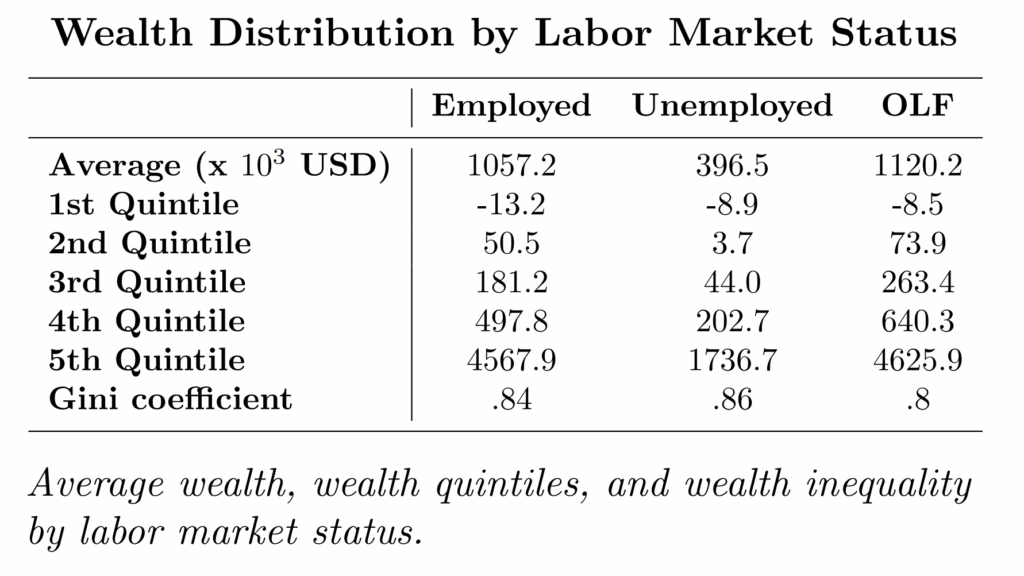
In the wealth distribution, OLF households possess the highest average wealth, slightly exceeding employed households and far surpassing the unemployed. The OLF category reflects the heterogeneity within the group, with retired households possessing a substantial amount of assets and discouraged workers with limited resources.
Occupation and inequality
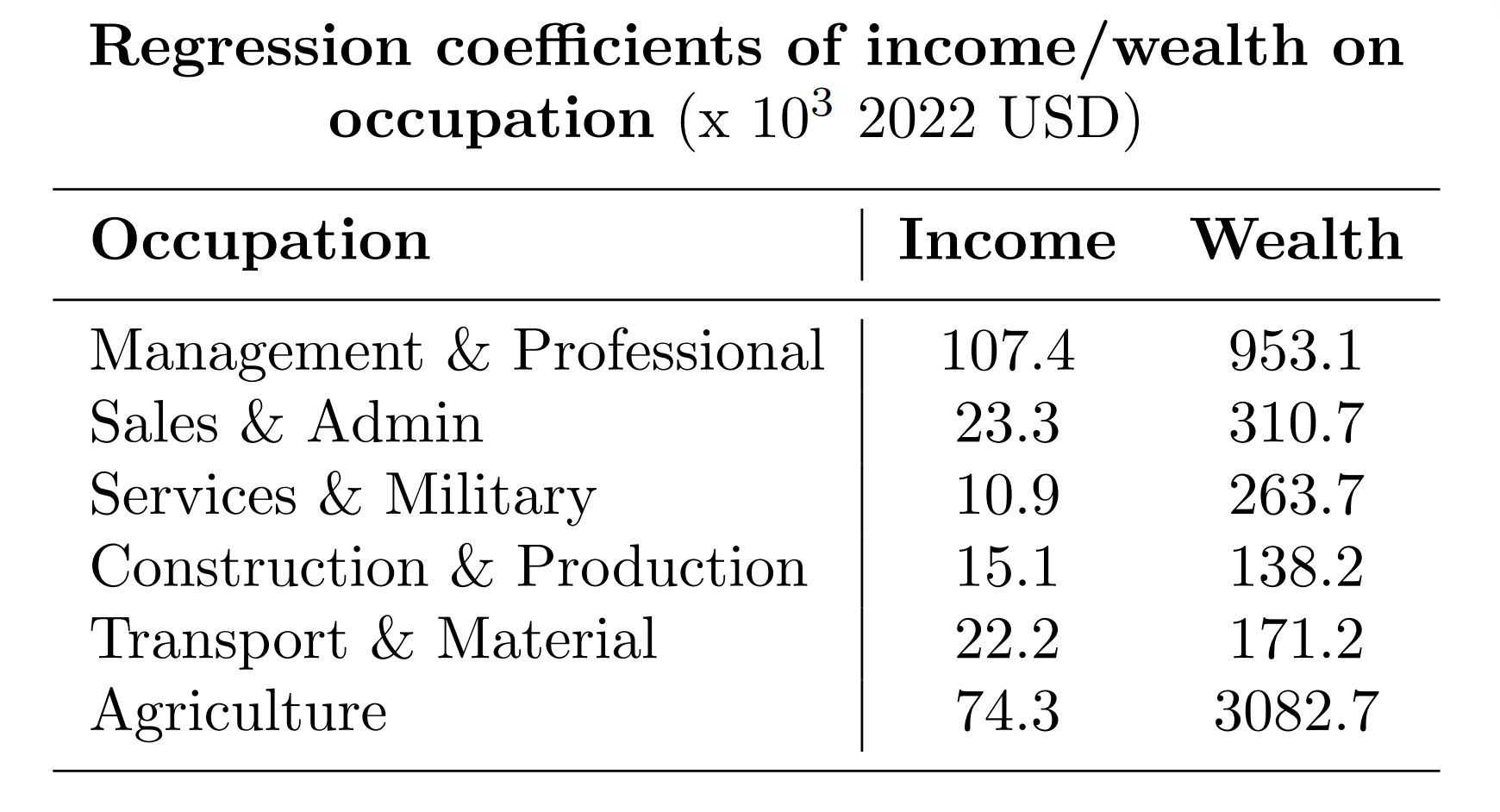
These regressions focus on the relationship between financial situation and occupations of employed workers. To control for other household characteristics correlated with income and wealth when analyzing between-occupation differences, income (wealth) is regressed on occupation dummies along with control variables. The estimated coefficients are reported relative to the reference group reporting no work for pay.
Across all occupation groups, differences in income and wealth are only weakly correlated. Households in management occupations earn the highest income while those in protective, cleaning, food processing and other low skill occupations are the ones that earn the least. Workers in agriculture stand out with the second highest income. They also stand out when looking at wealth with the by far highest wealth difference of more than 3 million across all occupations. The second wealthiest households are in management occupations with almost 1 million dollar more wealth than the reference group.